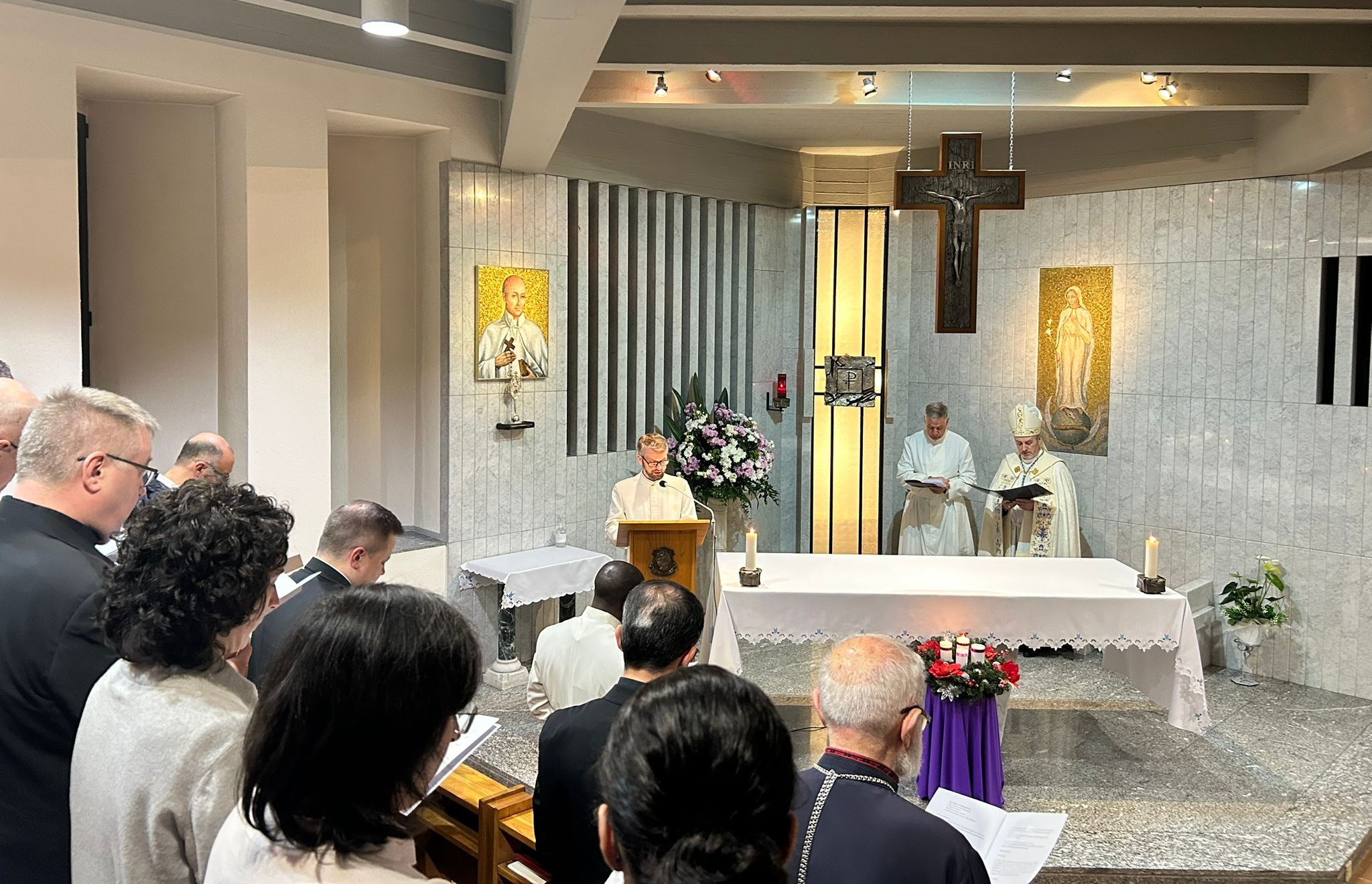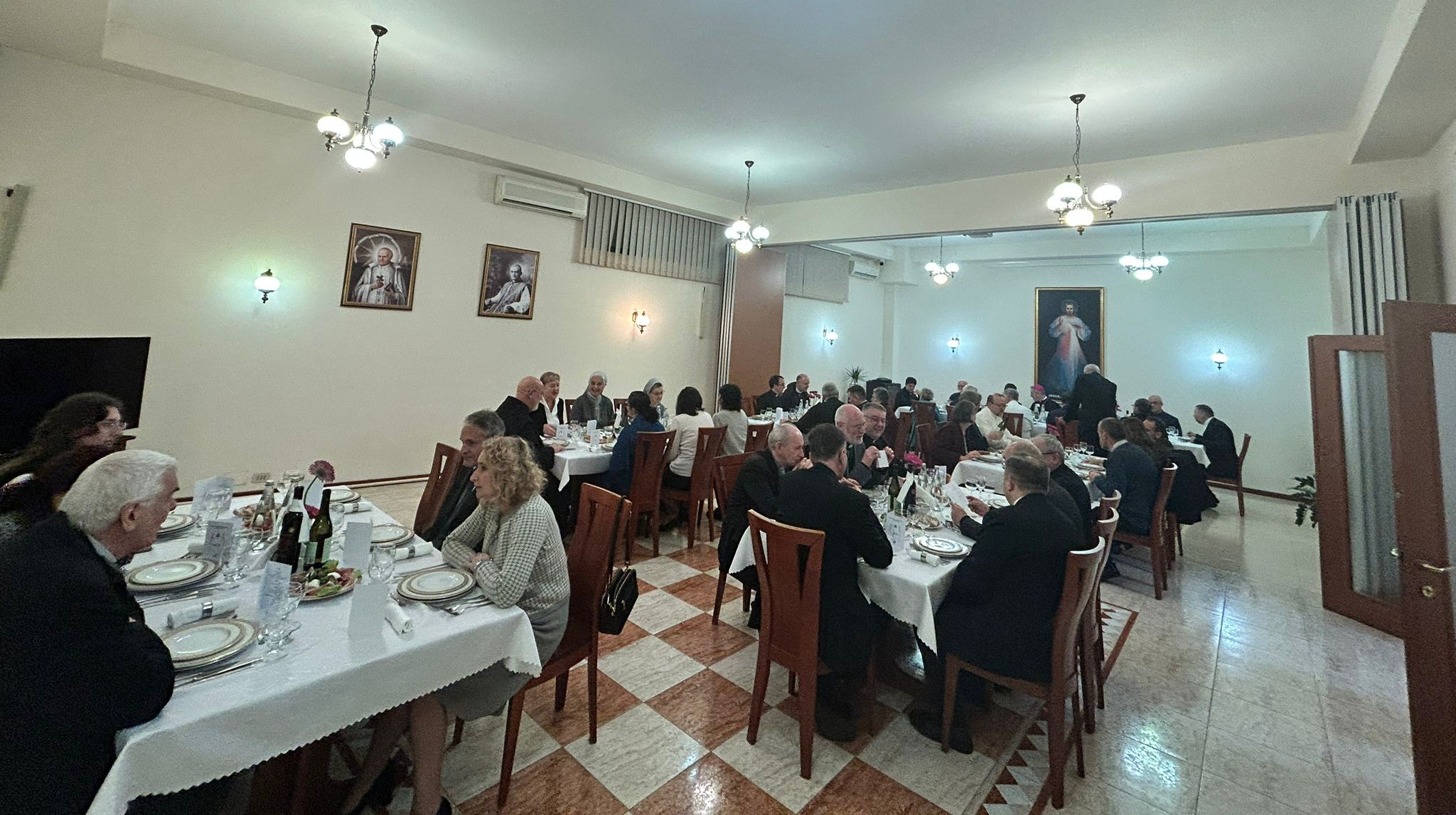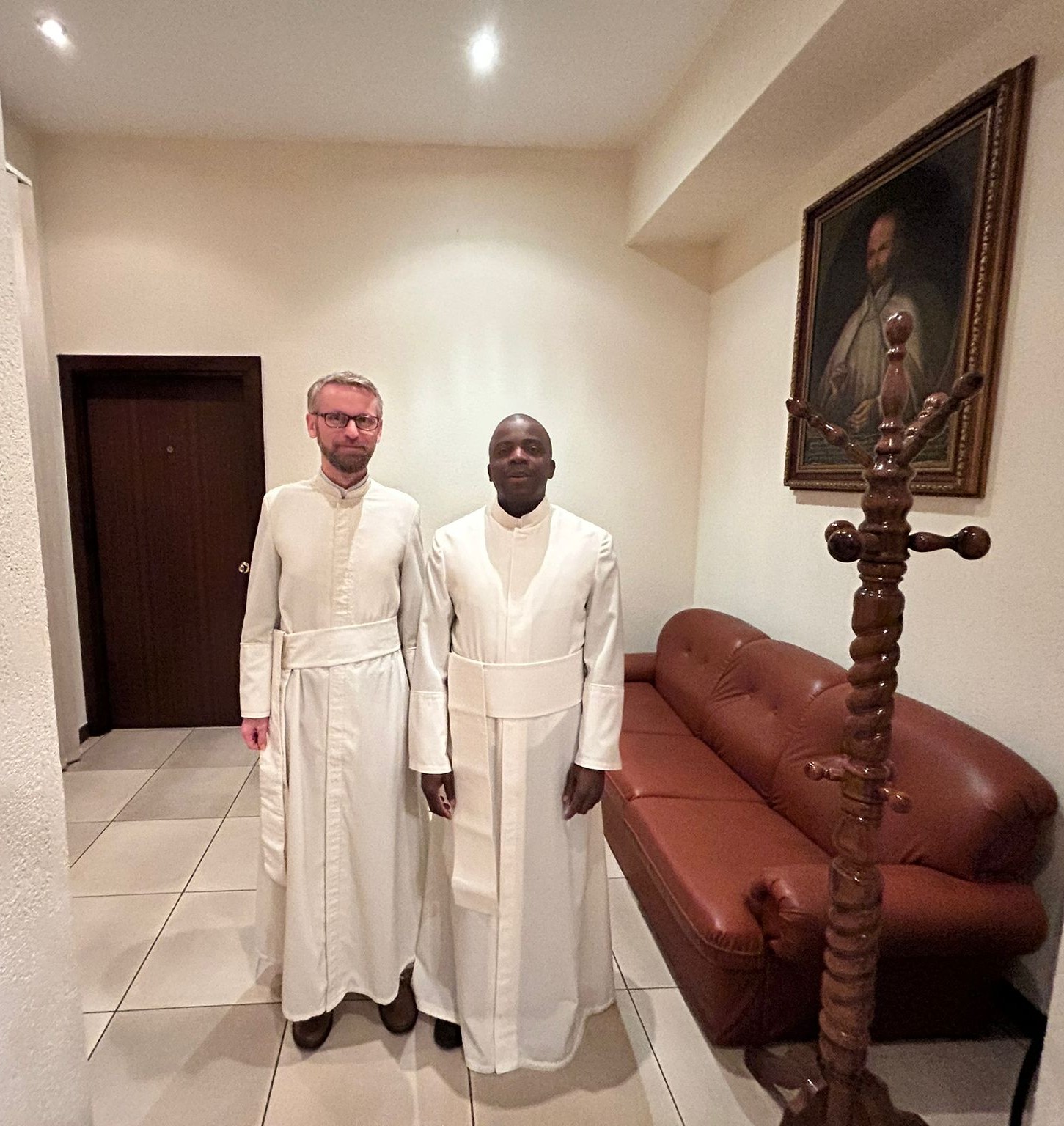

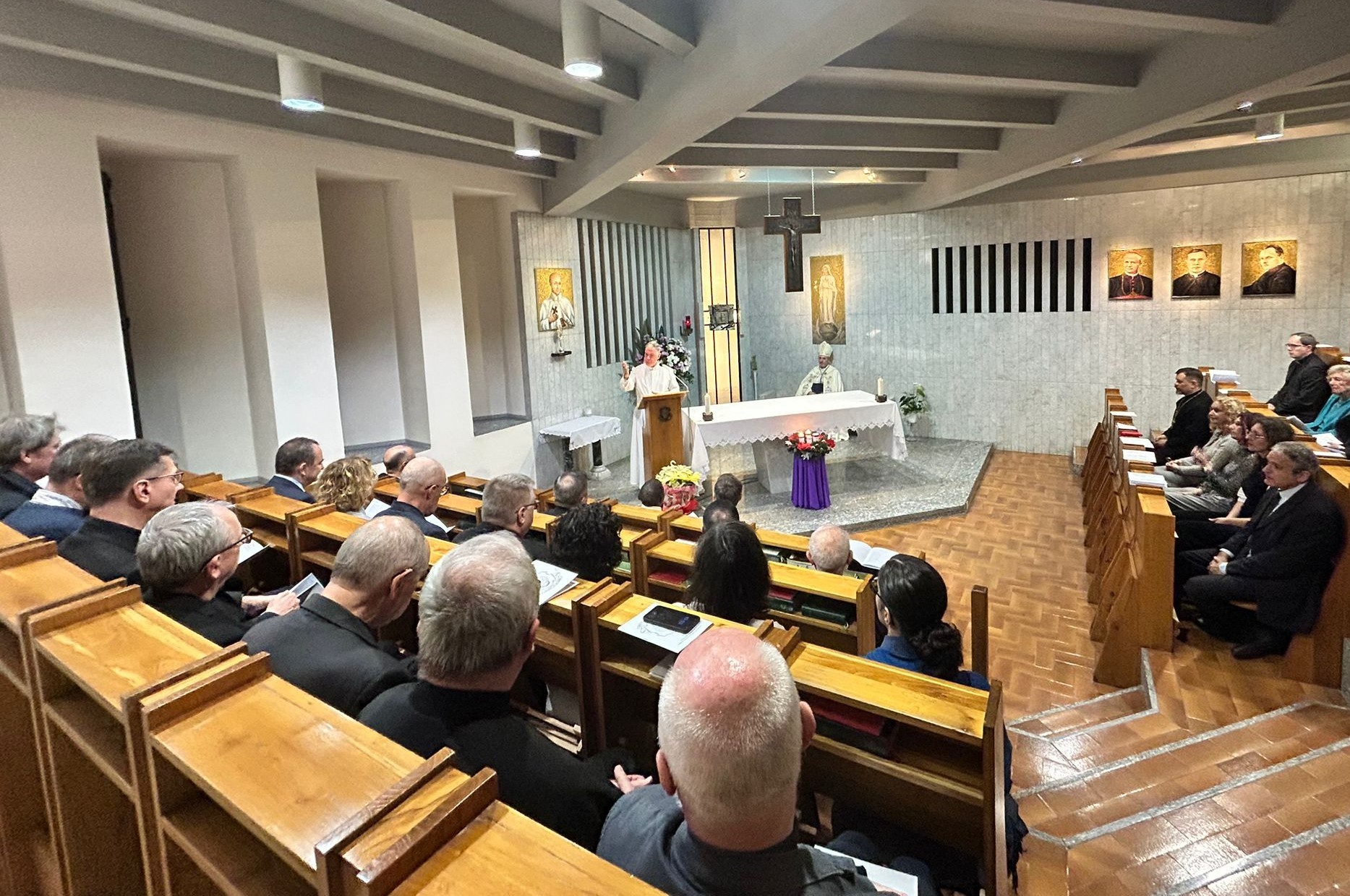
I believe that we all had something in common in our catechetical formation: from an early age, our parents taught us the Hail Mary. If we feel at home among the Marian Fathers, it is not only because of their generous hospitality, but also because they have chosen to be disciples of the Lord together with Mary.
I remember that at school, some teachers began the lesson with this prayer, and at noon we all stopped to recite the Angelus together. Even at the Congregation for the Doctrine of the Faith, where I work, it is customary to gather every day at noon for this prayer.
Often, precisely because we have known it for so many years, we recite the Hail Mary a little hastily or perhaps with too much familiarity. On this occasion, during this evening’s celebration dedicated to the Virgin Mary, I would like to share a brief reflection with you, in the hope that together we may rediscover the beauty of this prayer.
The Hail Mary is a Christian prayer addressed to the Virgin Mary, composed of two parts, the first of biblical origin and the second of ecclesiastical tradition.
The first words, “Hail, Mary, full of grace, the Lord is with thee,” echo the greeting of the Angel Gabriel to Mary at the Annunciation (Luke 1:28). I discovered that Gabriel is mentioned four times in the Bible, twice in the Old Testament (Dan 8:16; 9:21) and twice in the New Testament. Gabriel is best known for announcing the birth of John the Baptist to Zechariah and, more famously, the incarnation of Jesus to Mary.
The archangel Gabriel says, “Hail, Mary” (Ave, o Maria in Italian). In Italian and English, the identity of the one uttering the greeting is clear: it is Gabriel.
In the French version of the prayer, however, the subject changes slightly and becomes “Je vous salue, Marie,” meaning “I greet you.”
What I find most significant, however, is the Spanish formulation: the subject is neither Gabriel nor the person praying, but God himself – “Dios te salve, Maria.”
“Ave” is a short word, but in our tradition of faith it carries a very profound meaning. We often forget that “Ave” – or “Rejoice” – is an expression of joy and greeting. For those of us who live in Italy, it may sound almost like a simple greeting, similar to our “salve,” which we use to say ‘hello’ or “good morning.”
But this word encompasses much more. By reversing the letters of “Ave,” we get “Eva,” which reminds us of the symbolic link between the first woman of ancient creation and Mary, the Mother of the new creation in Christ.
“Full of grace” indicates Mary’s unique condition, chosen by God to be the Mother of Jesus. Gabriel could have emphasized many of Mary’s qualities—her great faith, her love for Joseph, her goodness—but instead he emphasizes what comes from God: she is full of grace.
This title reminds us that God chose Mary as a worthy dwelling place for his Son, fulfilling his promise to reveal himself to humanity and to send the Savior.
“The Lord is with you” highlights God’s presence and action in Mary’s life, a sign of the New Covenant that is fulfilled in her and through her.
In this first part of the prayer, which is based directly on the Scriptures, we find the words—or rather the greeting—that Elizabeth addresses to Mary in Luke’s Gospel (1:42): “Blessed are you among women, and blessed is the fruit of your womb, Jesus.” With this phrase, Elizabeth recognizes Mary’s special role, blessed precisely because of her divine motherhood.
It is interesting to note that, in the Spanish version of the Hail Mary, it does not say “among women,” but “entre todas las mujeres” (among all women), an expression that further highlights Mary’s uniqueness among all women.
In the second part of the prayer, which belongs to ecclesiastical tradition, we invoke Mary as holy and Mother of God, asking for her intercession. The proclamation of Mary as Mother of God dates back to the Council of Ephesus in 431, which, affirming the dual nature, human and divine, of Christ, also recognizes that Mary is the mother of Christ and therefore of God himself.
The title “Mother of God” emphasizes Mary’s unique role in the history of salvation as the mother of Jesus, true God and true man. It also reminds us that holiness is real, it is our goal, and above all, it is possible because God himself is holy.
“Pray for us sinners” expresses trust in Mary’s intercession with God to obtain forgiveness and support. How many people throughout history have uttered these words? How many have found consolation and comfort by entrusting themselves to Mary, especially in the last moments of their lives?
The phrase, “now and at the hour of our death” emphasizes the continuity of this prayer: Mary accompanies us along the pilgrimage of life, until the moment of death and, symbolically, until the end of the world.
The last word, “Amen,” is an expression of assent and confirmation of the prayer. It also recalls Mary’s assent, who with her “yes” accepted God’s plan to become the Mother of the Savior.
In a sense, the prayer is like a tapestry that weaves together various elements, representing God’s plan from the beginning of time to the last day. As we recite it, we recognize Mary’s central role in the history of salvation and her holiness. We are invited to take her as a model of faith, hope, and charity.
The Hail Mary is a prayer that unites us to Mary, Mother of Jesus and Mother of the Church, and sustains us on the pilgrimage of faith, helping us to grow in holiness and love for God.
Let us conclude this meditation by entrusting ourselves to Mary, asking her to guide and accompany us every day: just as she said “yes” to God’s plan, so too may we learn to respond with faith and love. May the Hail Mary continue to be a source of consolation, strength, and holiness for us, today and always. Amen.